
Special Educational Needs
Sandy Lane Primary School is ambitious for all our pupils and we believe that there is no ceiling on what can be achieved by anyone, regardless of their circumstances or background. We are committed to providing a supportive and inclusive learning environment, giving every young person the opportunity to fulfil their potential now, and in the future.
The leaders at Sandy Lane are leaders for all pupils, enabling our teachers to be teachers of all pupils. We are committed to distributed leadership to secure the best possible provision and outcomes for pupils with special educational needs. We have the same ambition for all our pupils, and recognise the importance and impact of prioritising our responsibilities to pupils with special educational needs.
We work in partnership with pupils and their families in identifying and providing for special educational needs. Where appropriate, we also work in partnership with other agencies. We recognise the importance of communication being inclusive, accessible and culturally sensitive to achieve effective partnership working.
Our graduated approach
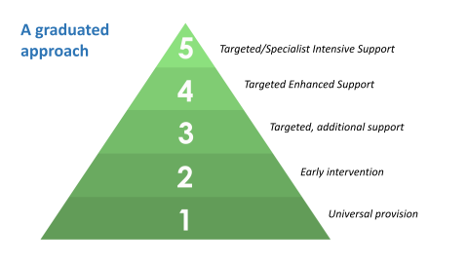
At Sandy Lane Primary School, we have a graduated approach to pupils’ needs. All teachers receive training on what this looks like for pupils in our school and their roles and responsibilities in this process. The diagram below shows this process:
What does it mean to have a special educational need?
A pupil has SEN if they have a learning difficulty or disability that requires special educational provision to be made for them.
They have a learning difficulty or disability if they have:
-
A significantly greater difficulty in learning than most others of the same age; or
-
A disability that prevents or hinders them from making use of facilities of a kind generally provided for others of the same age in mainstream schools.
Special educational provision is educational or training provision that is additional to, or different from, that made generally for other children or young people of the same age by mainstream schools.
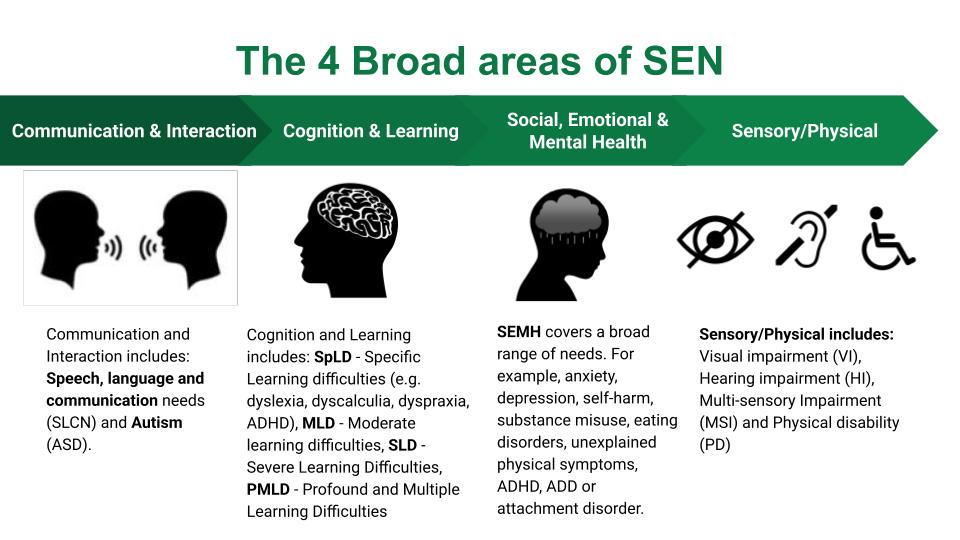
What this means at Sandy Lane
At Sandy Lane Primary School we take a holistic as well as individualised approach to curriculum adaptations. Teachers are expected to plan for the pupils they teach using their knowledge of pupils and using information, such as the Individual Learning Plan (ILP), to inform this. Across the school we promote flexible grouping for the majority of the school day. Pupils are encouraged to engage with the resources that are made available and the modelling that takes place through the teaching. Where appropriate, pupils can have access to additional support and/ or accessibility tools/ aids (such as a laptop) as needed.
We have two sensory spaces available across the school. These are located at either end of the school and are timetabled for the delivery of interventions as well as available at set times to pupils who require a movement break as agreed as part of the passport review process or as a responsive support measure. One is a sensory room that provides access to a sensory space and equipment, such as a ball pit, low lighting, and sensory resources. The other is our Cubbie which provides an immersive calming sensory experience
Our SEND Team
|
Lloyd Walsh, SENCO
|
I am dedicated to providing the support necessary for all children to access the curriculum and engage fully in school life. With a passion for inclusion and high expectations at the core of my work, I value the power of partnership, working with families and external agencies to offer a wide range of interventions. |
|
Katie Parkhouse, Headteacher
|
Learning isn't just something that happens in a classroom; it’s a journey we’re all on together. We hold the highest aspirations for every single child, irrespective of background, SEND or prior attainment. By keeping home and school life connected, we can make sure every child has what they need to really thrive. |


Identification and assessment of children with SEND
Parents/carers are informed when pupils are added to or removed from the SEN register. When deciding whether special educational provision is required, we will start with the desired outcomes, including the expected progress and attainment, and the views and aspirations of the pupil and their parents/carers. We will use this to determine the support that is needed and whether this can be provided by adapting our core offer, or whether something additional is needed.
We work in close partnership with families and local settings. Many pupils with special educational needs will therefore be identified through the transition and induction process.
Transition to school is carefully planned to give time for observations and assessments of children as they join the school when required. Where there are any concerns with regard to a child’s development against developmental milestones, the school will speak with the parent to identify next steps.
Class teachers make regular assessments of progress for all pupils and identify those whose progress:
- Is significantly slower than that of their peers starting from the same baseline
- Fails to match or better the child’s previous rate of progress
- Fails to close the attainment gap between the child and their peers
- Widens the attainment gap
- Demonstrates high levels of dysregulation
This may include progress in areas other than attainment, for example, social needs. Attendance and behaviour data might also be used to identify which pupils require additional support. A graduated approach to SEND identification is followed at Sandy Lane Primary School so that an assess, plan, do, review process is used to identify strengths and barriers and plan for support.
Slow progress and low attainment will not automatically mean a pupil is recorded as having SEN.
Where a parent/carer has a concern about their child, parents are asked to speak with the class teacher so that appropriate observations and assessments can be undertaken.
Individual Learning Plan (ILP)
An Individual learning plan is a regularly reviewed document that contains the needs, strengths and individual strategies for every pupil with an EHCP or on SEN Support. These are developed in partnership with pupils and their parents/carers. Where appropriate, they might also include strategies recommended by other professionals. Teachers are made aware of pupils' strengths, needs and appropriate adaptations and adjustments via the Individual Learning Plan (ILP). They also:
- Track progress against long-term outcomes in Educational, Health and Care Plans (EHCNAs) for pupils working below age related expectations
- Inform medium-term and daily curriculum planning and provision where children are accessing adapted curriculum pathways
- Inform intervention planning
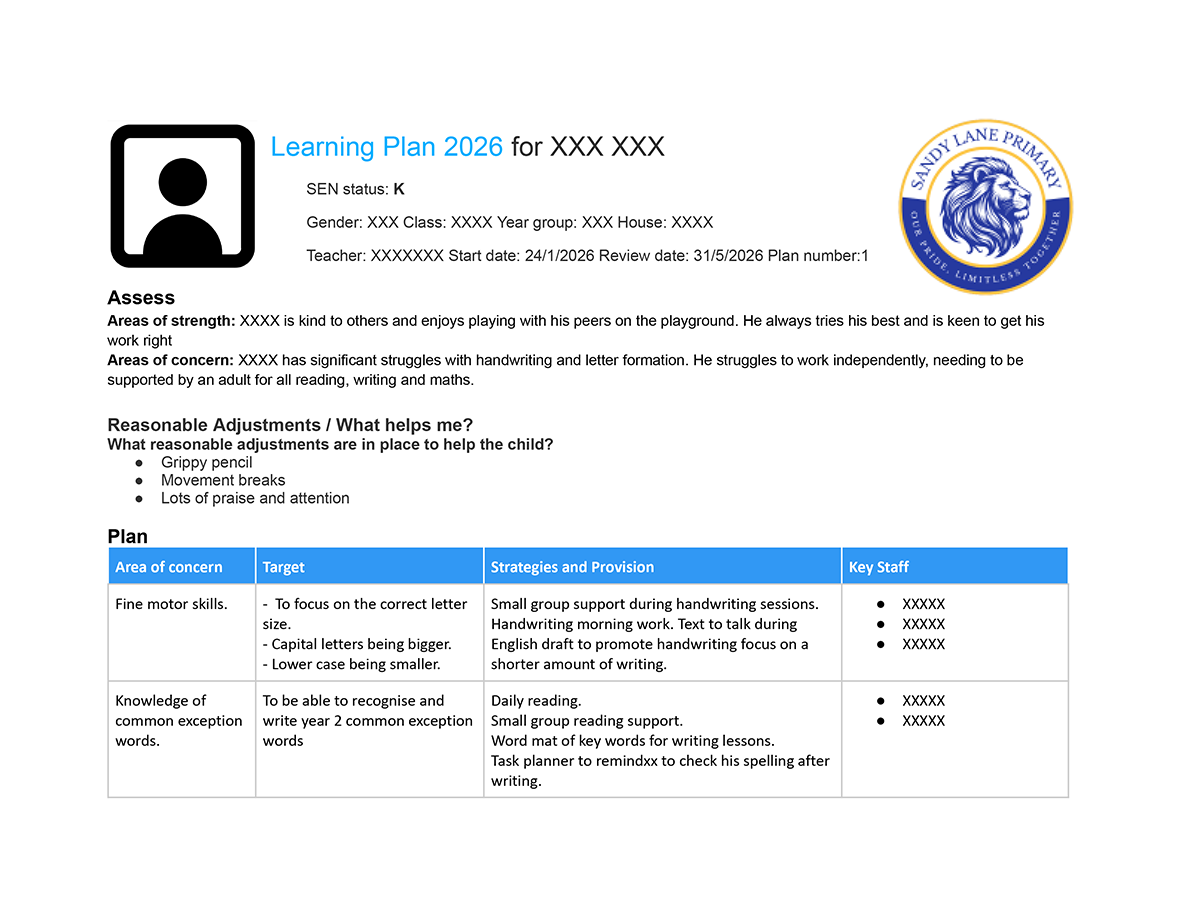
A link to this example of an individual learning plan can be found here.
Universal provision – high quality teaching
Sandy Lane Primary School ensures that a universal provision of high quality teaching is able to address gaps in foundational knowledge and skills. Through evidence-informed classroom routines and a well-planned curriculum, teachers are able to address reading fluency and accuracy, communication and language skills, writing composition and number facts. Our carefully selected and sequenced curricula ensure foundational subject-specific knowledge is secure at every step. For some pupils, effective targeted support in class ensures gaps are identified and tackled quickly through our responsive and adaptive classroom practice.
Teachers are made aware of pupils' strengths, needs and appropriate adaptations and adjustments via the Individual Learning Plan (ILP). The plan guides teachers to know which strategies to prioritise for each pupil and/or which reasonable adjustments are required to ensure the pupil can access the learning.
Targeted support
At Sandy Lane Primary School, we have the following interventions:
- Zones of Regulation (for pupils who struggle to recognise, express and manage their emotions to develop the skills for self regulation).
- Den groups (to support pupils to overcome barriers to learning by building confidence, self-esteem, and essential social skills within a safe, nurturing environment, enabling them to thrive in mainstream classes).
- Attention Bucket (to support pupils to build fundamental communication, attention, and social skills through highly engaging, visually stimulating, and fun activities).
- Sensory Circuits (for pupils experiencing regulation difficulties or with sensory needs that benefit from sensory activities to maintain regulation throughout the school day).
- Sensory Room and Cubbie (for pupils with sensory needs who require time and space in a calming environment to support sensory regulation).
- Dog Therapy (to support pupils reduce anxiety, build emotional confidence, and improve social or communication skills through a non-judgmental, calming presence).
- Where appropriate, teachers are made aware of the focus of any intervention so that they can support pupils to generalise the skills learnt back to the classroom.
Specialist support
At Sandy Lane Primary School, we work in partnership with a range of external agencies and they will support with the planning and delivery of specialist interventions. This might include mentoring, specialist speech and language therapy sessions focused on speech sounds, Occupational Therapy or access to specialist Mental Health support.
Where appropriate, teachers are made aware of the focus of any intervention so that they can support pupils to generalise the skills learnt back to the classroom.
Interventions are reviewed at least every term to check the impact against the intended outcome. Where the intervention is not having impact as expected, changes will be made to the intervention.
Sandy Lane Primary School also has a Special Resource Provision (known as Foxes) for pupils with ASD and Speech, Language and Communication Needs. This resource provision is commissioned by the local authority. Admissions to the Specialist Resource Provision is separate from the main school. The resource provision is for pupils with an Education Health Care Plan. For more information about the resource provision, please read the provision statement which can be found here: Sandy Lane Primary School ERP Provision Statement.
Staff training
Our SENCO is an experienced teacher currently completing his NPQSENCO qualification. The school prioritises time for the SENCo to be able to work alongside other staff in the school to build expertise in the classroom, for example, through coaching so that all teachers build their confidence and competence.
TAs have attended whole school training where relevant and have available additional recorded training. Some staff receive training in a particular specialism, such as working with Speech and Language therapies (S<), in order to deliver targeted interventions. Other SEND-specific training has been delivered, such as Autism Support Assistant training, ELSA, Nurture.
Useful links
Teacher Handbook: SEND
With contributions from specialists across the sector, the handbook is a comprehensive resource for teachers and parents to use over time. It brings together practical examples of high-quality teaching - placing focus on removing barriers to learning, getting to know and understand individual learners, and bringing to life the graduated approach. To access this free resource click on the link below and sign up to Whole School SEND:
Whole School SEND Online CPD Units
Free, flexible online learning to help develop inclusive practice.
Our SEN policy, SEN Information report and accessibility plan can be found on our School Policies & Documents page here.
Our SEND local offer can be found here.